
Maury Parole and Probation Compared
Parole and probation both allow a person to live in the community under rules, but they begin under different authority. Parole is conditional release before a prison sentence expires. The Tennessee Board of Parole decides parole matters, while Tennessee Department of Correction community supervision manages field supervision. Probation comes from a court. A judge may order it instead of incarceration or after a period of split confinement, which means part of the sentence is served in custody and the rest under supervision.
A Maury County Jail release record may say probation, parole, time served, or transfer. That entry identifies the jail event, not the whole legal history. A person released on probation should also have a court judgment defining the term. A person released on parole should have a Board action and a TDOC record. Full discharge means the responsible authority shows the sentence or supervision has ended. It should not be inferred merely because the person left the jail.
| Point | Parole | Probation |
|---|---|---|
| Authority | Tennessee Board of Parole | Sentencing court |
| When it begins | Conditional release before sentence expiration | Instead of incarceration or after split confinement |
| Public verification | FOIL status, Board result, assigned office | FOIL when TDOC supervises, court judgment, assigned office |
| Key record | Final Board action and TDOC supervision record | Court judgment and supervision record |
- Parole
- Conditional community release authorized by the Board before a prison sentence ends.
- Probation
- A community-based sentence ordered by a court, sometimes after a jail term.
- Discharge
- The recorded end of custody or supervision under the responsible authority.
- Absconder
- A person alleged to have stopped reporting or left supervision without approval.
Verify Maury Post-Release Supervision
The public starting point is TDOC Felony Offender Information Lookup, known as FOIL. It includes many people currently or formerly in TDOC custody or supervision. Search by exact TOMIS or State ID when known. A name search can use last name, first name, race, and aliases, but common names require careful identity checks. FOIL does not cover every short county booking or every misdemeanor probation case.
- Match the person with a TOMIS or SID, date details, and other lawful identifiers. A name alone is weak.
- Read “Supervision Status” and “Assigned Location” together. Do not treat a location label by itself as proof of custody or freedom.
- Review sentence dates, active sentences, and “Parole Hearing Result.” An inactive label needs the dates and case context.
- Check the Maury court judgment when probation was imposed by a court or when FOIL has no qualifying record.
- Call the assigned supervision office when the public entry is unclear, old, or conflicts with another official record.
No result does not prove that supervision ended. A spelling mismatch, old record, out-of-state compact case, or misdemeanor supervision outside TDOC can explain the gap. Interstate supervision may be checked through the Interstate Compact Public Web Portal, subject to that portal's limits. For the full county release record and court path, use the Maury County released inmate search.
Important: A release from Maury County Jail can be followed by probation, parole, another agency's custody, or no supervision. Confirm each layer separately.
Maury Supervision Office Details
TDOC District 51 serves Maury County along with Giles, Lawrence, Lewis, Perry, Wayne, and Williamson Counties. Its Maury/Lewis/Perry office is the local point for an assigned person whose FOIL record directs inquiries there. The official directory supplies the address and telephone number but does not publish a walk-in schedule. Call before visiting.
TDOC District 51
Maury/Lewis/Perry Office
2506 Pillow Drive, Suites A & B
Columbia, TN 38474
Phone: 931-380-2575
Fax: 931-381-6484
Hours: Confirm by telephone
The office can clarify an assigned location or reporting point when identity and lawful access permit. TDOC says a probationer must report to the probation/parole officer within 48 hours after placement or release. That rule does not turn the office into a public locator for a person's real-time whereabouts. Use FOIL for the public status, the court for probation authority, and the Board for final parole action.
Assigned Location needs context. It may identify a community-supervision office, a prison, or a local jail holding a TDOC felon. Read it with Supervision Status before deciding whether the person is in the community. District 51 serves a broad group of counties, so an office assignment in Columbia does not by itself establish a home address or current physical location. When FOIL and a court record differ, give the office the TOMIS number and ask which agency owns the latest supervision entry.
Note: No official statewide TDOC absconder list was found, so an ambiguous public status should be checked with the assigned office.
Maury Parole Hearing Records
The Tennessee Board of Parole hearing schedules include separate state-prison and county-jail calendars. The Board says schedules update weekly on Monday, or Tuesday after a Monday holiday, and can change. Maury County Jail appears as a facility heading when it has a docket. The calendar is a notice of a future event. It is not proof that parole was granted or that physical release occurred.
The Board's hearing process covers grant, revocation, rescission, time-setting, custodial, and appeal matters. A hearing officer gathers facts and makes a nonbinding recommendation. Board members can adopt, change, or reject it. A final revocation can revoke parole or restore supervision. Rescission can undo a grant before or after release under defined conditions.
The manifest image below comes from the official Board description of its parole hearing process and hearing types.
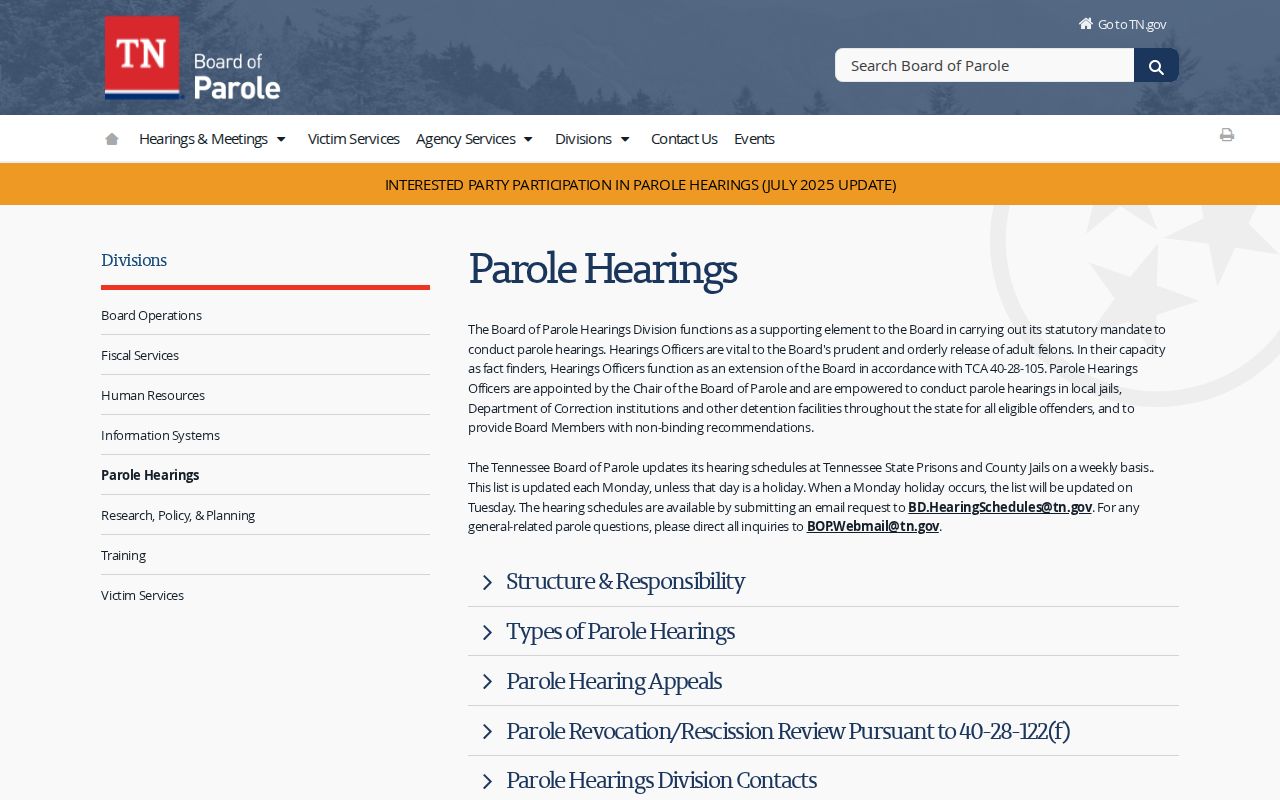
That Board page helps interpret the type of event, while FOIL's “Parole Hearing Result” is the person-level public result channel identified in the research.
If FOIL lacks a final action, contact the Board at 615-741-1150 or request the final decision through the Board public-records process. Do not label a recommendation as final. Appeals from denial, revocation, or rescission under T.C.A. § 40-28-105(d)(11) must be sought within 45 days of notice and are limited to the grounds stated in that law.
Eligibility also varies by sentence. T.C.A. § 40-35-501 and offense-specific laws control the first possible point for consideration. Offense date, conviction, range, sentence alignment, credits, and statutory exclusions all matter. There is no single eligibility percentage for every Maury County case. A scheduled hearing means the Board will consider a matter; it does not settle the outcome or set a physical release date.
Maury Supervision Changes and Violations
Conditions are the rules attached to parole or probation. The exact terms belong to the Board certificate, court judgment, and supervision documents. At a high level, a person may have reporting, residence, treatment, travel, or other case-specific duties. Do not infer the actual rules from a general web page. A violation allegation is not the same as a final revocation, and an arrest does not itself show the final outcome.
An absconding allegation means the agency claims the person stopped reporting or left authorized supervision. Maury research found no public statewide TDOC absconder list. A warrant, revocation docket, updated FOIL status, or agency confirmation is needed. Tennessee SAVIN and VINELink are useful for reported custody events, but they are notification tools rather than certified supervision records. A missing alert is not proof that no action occurred.
Mandatory reentry supervision adds another category. T.C.A. § 40-35-506 applies to covered felony offenses committed on or after July 1, 2021. Depending on the sentence facts, the last year may be served in the community or a supervision year may follow sentence expiration. This is why a sentence-end date cannot answer every supervision question by itself.
Maury Release Care Continuity
Maury County's 2025 opioid-abatement report documents local transition work inside the jail. It identifies South Central Tennessee Workforce Alliance R.E.A.C.H. programming and trauma therapy in place since 2020. The described work includes counseling, navigation, and case management. Delta Recovery's Women's Jail Intensive Outpatient Program uses rolling 12-week cohorts and connects care near release with Fresh Start after release.
These programs are not parole decisions, probation records, or guarantees of a person's release plan. They are part of Maury's documented care-continuity landscape. Their role matters because parole release can depend on approval of a proposed plan, while probation and reentry may bring separate reporting and service needs. The county funding report is the source for the local program facts.
Maury Supervision Discharge Records
Supervision ends through an official discharge, termination, sentence completion, or other recorded action. FOIL may show an inactive status and sentence dates, but “inactive” is not a full account. Read it with active sentences, release information, assigned location, and court or Board records. A person who left incarceration on parole is released from confinement but is not fully discharged until the responsible authority records the end of supervision.
For an old or incomplete TDOC entry, request archived records such as the release authorization, sentence computation history, and discharge entry. Supply the full name, TOMIS number, date of birth, and a narrow record description. TDOC warns that archive charges may apply and instructs requesters not to prepay. The archive office answers questions at 615-253-8079. The court remains the durable source for the probation judgment, later revocation, or termination order.
Note: Compare the jail release event, court authority, FOIL status, and final Board action before describing Maury County supervision as complete.