
Maury Scheduled and Actual Release
A projected date is a calculation or eligibility milestone. Actual release is the custody event recorded by the jail or corrections agency. Tennessee's FOIL detail page does not use the label “Projected Release Date.” Its exact fields are “Release Eligibility Date” and “Sentence End Date.” The first marks an eligibility point under the applicable law. It does not promise parole. The second is a calculated sentence endpoint in TDOC's data. Neither field alone fixes the time someone will walk out.
County and state records cover different people. A pretrial Maury County Jail detainee may have no sentence calculation at all. Bond, a judge's order, a dismissal, and holds from other agencies drive that person's custody. A TDOC felony offender may have FOIL dates even if the arrest began in Maury County. A transfer from the jail to TDOC ends county custody but is not community release.
Scheduled vs actual: A FOIL eligibility date or sentence end date is not the Sheriff's door-out timestamp. Confirm the completed event with the agency holding the person.
Find a Maury Inmate Release Date
Begin with the last known custodian. For a person held only by Maury County, call Booking at 931-375-8661 or Corrections at 931-380-5733. Ask whether the person remains in county custody and whether any exit was a community release or a transfer. For a state sentence or known TDOC transfer, use TDOC FOIL. The exact TOMIS or State ID is safer than a common name.
- Identify the last agency that held the person and match at least two stable identifiers.
- Use FOIL for a qualifying Tennessee felony record. Search by TOMIS, SID, or name and aliases.
- Read “Release Eligibility Date,” “Sentence End Date,” status, assigned location, active sentences, and parole fields together.
- For county custody, obtain the Maury jail release entry and court judgment. Do not expect every short booking to appear in FOIL.
- Check another agency when the record shows TDOC, extradition, a detainer, ICE, or federal transfer.
- Confirm near the date with the custodian and use a custody alert as a prompt to check again.
The Maury court docket can explain a bond order, sentence, jail credit, split confinement, probation, revocation, or dismissal. It may not show the minute jail staff finished processing. The jail release record answers that operational question. The Maury County released inmate search explains how to reconcile those records for a completed release.
Identity checks matter at every step. Compare the full name with date of birth, booking number, case number, TOMIS or SID, and the relevant arrest date. One booking can lead to several court cases, and one sentence can contain several counts. A same-name FOIL result may belong to someone else. Dates should form a sensible sequence from arrest and judgment through eligibility and release. If they do not, preserve the conflict and ask the records custodian to explain it.
Note: “Bond set” means a judicial amount or condition exists; it does not establish that bond was posted or that jail processing ended.
Maury FOIL Release-Date Fields
FOIL covers felony offenders currently or formerly in TDOC custody or supervision. It does not cover every person arrested in Maury County. The direct search offers name, TDOC/TOMIS ID, and SID routes. On the name tab, last name is required; first name, race, and an include-aliases option can refine the result. CAPTCHA is required. MyTN also provides FOIL under Public Safety, but it is not a Maury Sheriff jail-release app.
| FOIL field | How to read it |
|---|---|
| Supervision Status | Shows a TDOC category such as incarceration, parole, probation, or inactive; read dates and sentences too. |
| Assigned Location | Identifies the TDOC location or supervision assignment, not freedom by itself. |
| Sentence End Date | Calculated endpoint based on sentence data held by TDOC; later data can change it. |
| Release Eligibility Date | Eligibility milestone under applicable law, not guaranteed parole or physical release. |
| Parole Hearing Result | Public result layer that may affect release, but plan approval and processing may remain. |
| Active Tennessee Sentences | Counts and terms that must be checked for concurrent or consecutive alignment. |
The official TDOC FOIL information page explains the service, while the direct search presents the live record fields. An inactive status is not a complete discharge narrative. Look for the sentence and release data, then request archived TDOC records if the old entry is missing or unclear.
FOIL can also show Combined Sentence(s) Length, Supervision/Custody Level, Sentence Begin Date, Parole Hearing Date, and current Tennessee sentences. Those fields can reveal why a single projected date is misleading. Consecutive counts run one after another, while concurrent counts may run at the same time. A parole hearing date identifies a proceeding, not a grant. Even a reported grant can precede release-plan approval and final processing.
The manifest image below shows the official TDOC offender search and released-result layout.
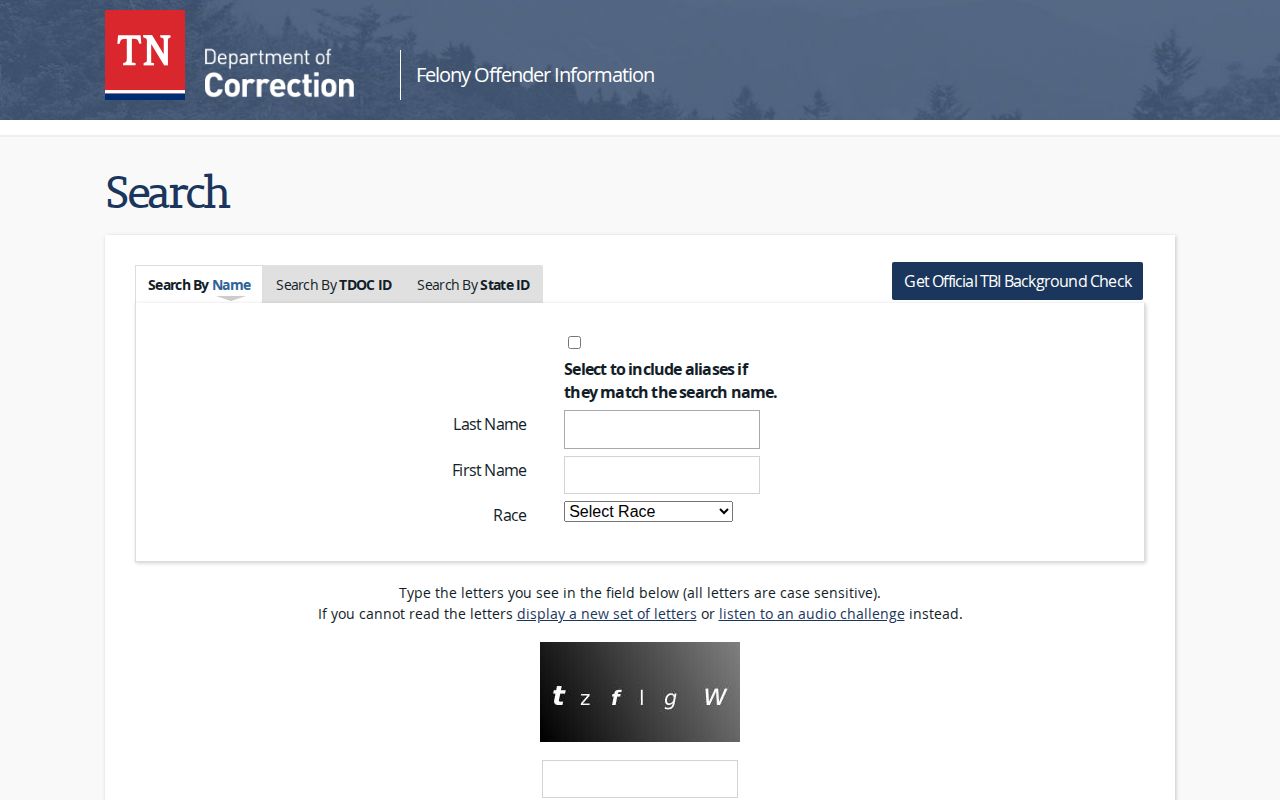
That search is the right public source for exact TDOC labels, but it should not be renamed into a guaranteed Maury County projected release date.
Maury Release Eligibility Rules
T.C.A. § 40-35-501 is the main Tennessee release-eligibility law. Subsection (r) directs TDOC to calculate sentence-expiration and release-eligibility dates for felony offenders sentenced to TDOC and for felony confinement of at least one year in a local jail or workhouse. Many ordinary short Maury bookings therefore will not have FOIL sentence dates.
Tennessee has no single “serve 85%” rule for all sentences. The percentage depends on the offense, offense date, range, and statutory subsection. Subsection (i) covers listed violent offenses and historical date rules. Subsection (u) applies 85% to specified repeat controlled-substance offenses committed from January 1, 2017, through June 30, 2022, with credits not reducing actual service below 70%. Subsection (t) addresses covered carjacking in its defined period.
For offenses on or after July 1, 2022, subsections (bb) and (cc) apply 100% treatment to listed offenses. Some categories permit credits without reducing service below 85%, while stricter categories do not permit a reduction. The offense-date provision must be read. A general percentage cannot replace the judgment, current statute, and TDOC sentence calculation.
Maury Sentence Credits and Dates
T.C.A. § 41-21-236 permits one to sixteen days of sentence-reduction credit per month. No more than eight days may come from good institutional behavior and eight from satisfactory program performance. Credits are reviewed and may be removed. They are earned, not a fixed discount that can safely be subtracted from the sentence at booking.
For sentences over two years tied to offenses on or after July 1, 2024, the statute makes credits affect parole eligibility rather than sentence expiration. Sentences under two years and earlier offenses receive different treatment under the statute. Subsection (f) addresses eligible local misdemeanants and court-fixed release percentages. Maury County research did not verify a separate local good-time formula. Do not import a generic county rule.
- Release eligibility
- The point at which a person may qualify for release consideration under the controlling law.
- Sentence expiration
- The calculated endpoint of the sentence after the applicable legal rules and data.
- Jail credit
- Time a court or corrections authority credits toward a sentence for prior custody.
- Detainer
- A notice that another agency may take custody when the current hold ends.
Credits interact with the offense statute, sentence length, parole framework, and later conduct. Only the responsible authority can apply them to the actual sentence record. The court judgment is needed for the conviction and sentence. TDOC holds the state computation.
Why Maury Release Dates Change
FOIL warns that dates can move when added court documents reach TDOC. Other changes come from the sentence record or later legal events. A projected date should be treated as a current calculation, not an unchangeable promise. Compare a saved result with the latest official record rather than assuming either is wrong.
| Factor | Possible effect | Record to check |
|---|---|---|
| Later court document | Corrects sentence terms, dates, or jail credit | Court judgment and TDOC computation |
| Concurrent or consecutive correction | Changes how multiple terms run together | Judgments and active sentence list |
| Earned or forfeited credit | Moves eligibility or expiration as the law permits | TDOC sentence history |
| Parole action | May permit release, deny it, or alter a prior grant | FOIL result and final Board action |
| Release-plan approval | Can delay physical release after a grant | TDOC and supervision record |
| Detainer or new case | Can produce transfer or continued custody | Release authorization and receiving agency |
| Revocation or appeal | May restore custody or change the active terms | Court or Board action |
Mandatory reentry supervision can also affect how the end of incarceration relates to the end of the sentence. A release to parole, probation, or mandatory reentry is a community release with continuing legal supervision. It is not the same as complete discharge.
A county release entry must also be read with its destination. “Released to TDOC,” extradition, or a named receiving agency closes the Maury County custody ledger while physical custody continues. A detainer is another agency's notice that it may assume custody when the current authority ends. Follow that record to the receiving system. Do not turn the first agency's release date into a claim that the person returned to the community.
Confirm a Maury Release Date
Check again close to the expected event. For Maury County Jail, ask Booking whether the person remains held and whether an exit was release or transfer. For TDOC custody, review FOIL and contact TDOC sentence information when the calculation needs an official explanation. If the record shows another agency, follow the custody chain to that agency.
Tennessee SAVIN/VINELink can send reported custody notifications. It is an event service, not a certified release sheet. Register on the correct person and agency record, then treat an alert as a reason to confirm. An alert may reflect the end of one agency's custody even when a detainer or transfer follows. The VINELink Release Check covers the Maury search and registration path.
For an old or incomplete TDOC record, use the TDOC archived-record request. Ask for the sentence computation/date history and release authorization, identify the TOMIS number and date of birth, and narrow the date range. TDOC warns that search charges may apply and says not to prepay.
Note: A release alert confirms a reported status event, while the custodian's release record documents the authority, date, and destination.